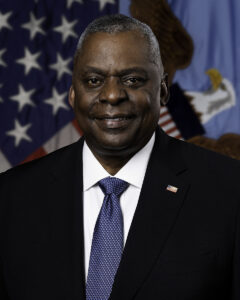
Secretary of Defense Lloyd Austin
Lloyd James Austin III, a retired four-star general of the United States Army, achieved a historic milestone as the first African American to hold the position of Secretary of Defense. Born on August 8, 1953, in Mobile, Alabama, Austin embarked on a distinguished military journey before transitioning to civilian leadership.
Military Career:
Education: Austin graduated from the United States Military Academy at West Point in 1975 and later
earned a master’s degree in counselor education from Auburn University.
Service: Throughout his military career, Austin held command and staff roles, showcasing leadership in the 82nd Airborne Division, the 10th Mountain Division, and the XVIII Airborne Corps.
Combat Experience: Notably, Austin garnered significant combat experience in Iraq during Operation Iraqi Freedom, where he commanded the 3rd Infantry Division, overseeing the capture of Baghdad in 2003.
Promotions: Rising through the ranks, Austin eventually attained the rank of four-star general, serving as the commander of United States Central Command (CENTCOM) from 2013 to 2016, overseeing military operations in the Middle East, Central Asia, and parts of North Africa.
Post-Military Career:
Transition to Civilian Leadership: After retiring in 2016, Austin initially delved into the private sector before being summoned back to public service by President Joe Biden.
Nomination and Confirmation: President Biden nominated Austin for Secretary of Defense in December 2020. Overcoming the legal requirement for military officers to be out of uniform for at least seven years, Austin received a waiver from Congress. The Senate confirmed him on January 22, 2021.
Historic Appointment: Austin’s tenure marked a historic moment as he became the first African-American Secretary of Defense. Throughout his service, he underscored the significance of diversity and inclusion in the military and national security.
Challenges and Priorities: As Secretary of Defense, Austin grappled with diverse challenges, including the withdrawal of U.S. troops from Afghanistan, addressing modern security threats, and tackling issues of extremism and sexual assault within the military.